Dental Bridge vs Implant: Which Lasts Longer?
Dental implants last longer than dental bridges. A well-placed implant can last a lifetime with proper care, while a dental bridge typically needs replacement every ten to fifteen years. Both are excellent solutions for replacing missing teeth, but they differ significantly in longevity, maintenance requirements, cost over time, and impact on surrounding teeth. If you are weighing your options, booking a consultation with a trusted Dental Clinic in Richmond Hill will give you a clinical evaluation tailored to your specific oral health needs.
The right choice between a bridge and an implant depends on more than durability alone. Factors such as your jawbone density, the condition of adjacent teeth, your overall health, and your lifestyle all play a role. Hummingbird Dental Clinic is one of the best dental clinics in Richmond Hill, and their team provides thorough assessments to help patients make confident, well-informed decisions.
What Is a Dental Bridge?
A dental bridge is a fixed prosthetic device that spans the gap left by one or more missing teeth. It consists of one or more artificial teeth, called pontics, anchored in place by crowns cemented onto the natural teeth on either side of the gap. These anchoring teeth, known as abutment teeth, must be filed down to accommodate the crowns, which is an irreversible process. The bridge is then bonded permanently and functions much like natural teeth for chewing and speaking.
Traditional bridges require healthy adjacent teeth to support them. If those neighbouring teeth are already compromised by large fillings, decay, or other issues, a bridge may actually be a practical solution since those teeth would need crowns regardless. However, if the adjacent teeth are healthy and intact, permanently altering them purely to support a bridge is a significant trade-off. Reliable Dental Care in Richmond Hill means being fully informed about your restorative options before a single appointment is booked.
Types of Dental Bridges
- Traditional bridge: Anchored to crowns on both adjacent teeth, the most common type
- Cantilever bridge: Supported by a crown on only one adjacent tooth, used when there is only one neighbouring tooth
- Maryland bridge: Uses a metal or porcelain framework bonded to the backs of adjacent teeth, preserving more tooth structure
- Implant-supported bridge: Anchored to dental implants rather than natural teeth, used when multiple teeth are missing
What Is a Dental Implant?
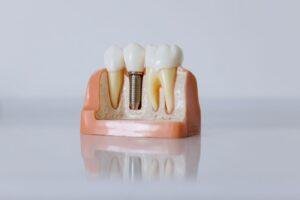
A dental implant is a titanium post surgically inserted into the jawbone to replace the root of a missing tooth. Over a period of three to six months, the implant undergoes osseointegration, the process by which the titanium fuses with the surrounding bone to create a stable, permanent foundation. A custom-made crown is then attached to the implant via a connector called an abutment, creating a tooth replacement that looks, feels, and functions like a natural tooth.
Unlike a bridge, an implant does not require alteration of any adjacent teeth. It stands entirely independently, which is one of its most significant clinical advantages. Because the implant integrates with the jawbone, it also stimulates bone tissue in the same way a natural tooth root does, preventing the bone loss that inevitably follows tooth extraction when no replacement is placed.
Longevity: Bridge vs Implant Side by Side
How Long Does a Dental Bridge Last?
On average, a dental bridge lasts between ten and fifteen years. With meticulous oral hygiene and regular professional care, some bridges last longer. However, several factors shorten bridge lifespan, including decay developing beneath the crowns on the abutment teeth, gum disease progressing around the bridge, and the natural wear of the pontic from chewing forces over time. When a bridge fails, it typically requires replacement, and the abutment teeth underneath may have deteriorated sufficiently to complicate the next restoration.
How Long Does a Dental Implant Last?
A dental implant itself, the titanium post in the jawbone, is designed to be permanent. With proper care and good general health, the implant post can last a lifetime. The crown attached to the implant typically needs replacement after ten to fifteen years due to normal wear, but replacing only the crown is far simpler and less costly than replacing an entire bridge. The total long-term cost of an implant, spread across decades, is often lower than multiple bridge replacements.
Key Differences That Affect Your Decision
Impact on Adjacent Teeth
Dentist in Richmond Hill professionals consistently highlight the protection of healthy adjacent teeth as one of the strongest arguments for implants over bridges. Preparing abutment teeth for a bridge involves removing a significant amount of healthy enamel and dentine. This permanently weakens those teeth, increases their sensitivity, and places them at a higher long-term risk of decay, fracture, and the need for root canal treatment.
Bone Preservation
This is one area where implants have a decisive advantage. When a tooth is lost, the jawbone beneath the socket begins to resorb because it no longer receives the stimulation provided by a tooth root. This bone loss is progressive and can alter the shape of the jaw over time, affecting neighbouring teeth and facial aesthetics. A dental implant replicates the stimulation of a natural root and halts bone resorption, preserving the structure of the jaw for decades.
Maintenance Requirements
Bridges require special flossing techniques to clean beneath the pontic, where food and bacteria collect and can trigger decay and gum disease if not removed thoroughly. Implants are cleaned exactly like natural teeth, with regular brushing and flossing. This simplicity contributes significantly to better long-term outcomes for implant patients who maintain good oral hygiene.
Who Is a Candidate for Each Option?
Good Candidates for a Dental Bridge
- Patients who do not have sufficient jawbone density for an implant and prefer not to undergo bone grafting
- Patients who need a faster solution, as bridges can often be placed in two to three appointments
- Patients whose adjacent teeth already need crowns for other reasons
- Patients with uncontrolled health conditions that make surgery inadvisable
Good Candidates for a Dental Implant
Hummingbird Dental Clinic conducts thorough clinical and radiographic assessments at 10376 Yonge St #202, Richmond Hill, ON L4C 3B8, to confirm implant candidacy before any treatment plan is finalised. Ideal implant candidates include:
- Adults with fully developed jaws whose adjacent teeth are healthy and intact
- Patients with adequate jawbone density to support the implant post
- Non-smokers or patients committed to quitting, as smoking significantly impairs healing
- Patients with well-controlled health conditions and no contraindications to surgery
Common Patient Mistakes When Choosing Between Bridge and Implant
- Choosing a bridge purely to avoid surgery without fully understanding the long-term implications for adjacent teeth and bone
- Delaying the decision for months or years, during which bone loss reduces implant candidacy
- Assuming the upfront cost determines the total lifetime cost, without accounting for bridge replacement cycles
- Not asking about implant-supported bridges as an option when multiple consecutive teeth are missing
- Neglecting post-procedure care, which is the most common reason both bridges and implants fail prematurely
Prevention and Maintenance Tips
Whether you choose a bridge or an implant, long-term success depends heavily on consistent maintenance:
- Brush twice daily and floss at least once per day, using a floss threader or water flosser for bridge care
- Attend professional check-ups and cleanings every six months without exception
- Avoid chewing ice, hard candy, or other extremely hard foods that can crack porcelain restorations
- Wear a custom nightguard if you grind your teeth during sleep, as bruxism places enormous stress on both bridges and crowns
- Report any looseness, pain, or change in fit immediately. Early intervention almost always prevents more complex and costly problems
To discuss your specific situation, contact Hummingbird Dental Clinic at (647) 370-2024 or info@hummingbirddental.ca. You can also explore the full range of Dental Implants in Richmond Hill services the clinic provides to find the right solution for your smile.
Frequently Asked Questions
Is a dental implant always better than a bridge?
Not always. Implants are generally considered superior in terms of longevity, bone preservation, and protection of adjacent teeth. However, bridges are appropriate when bone density is insufficient, when surgery is contraindicated, or when adjacent teeth already need crowns. A clinical assessment is the best way to determine which is right for you.
Can a dental bridge be replaced with an implant later?
Yes, in many cases a bridge can be removed and an implant placed, provided the jawbone still has adequate density. The longer you wait, the more bone loss may occur, potentially requiring a bone graft before implant placement.
Does getting an implant hurt?
Implant surgery is performed under local anaesthesia and most patients report less discomfort than they expected. Post-operative soreness is manageable with over-the-counter pain relief in most straightforward cases.
How do I clean under a dental bridge?
A floss threader, superfloss, or water flosser is used to clean beneath the pontic. Your dental hygienist will demonstrate the correct technique at your next appointment.
What happens to the bone under a bridge?
The jawbone beneath a bridge pontic continues to resorb over time because it receives no stimulation from a root or implant. This is one reason implants are often the preferred long-term solution, as they actively preserve bone through osseointegration.
Conclusion
Dental implants outlast bridges significantly when measured over a lifetime, but the best choice depends on your individual clinical picture. Consulting with a qualified dental professional, reviewing your bone health, and understanding the long-term maintenance requirements of each option will lead you to the most appropriate decision for your smile, your health, and your budget.