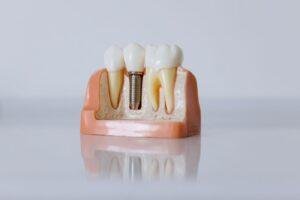
Black triangles are the small dark gaps that appear between teeth just below the contact point, where gum tissue used to sit. They’re caused by the gum papilla shrinking back or never filling the space in the first place.
They’re common, and in most cases they’re a cosmetic concern rather than a health emergency. That said, they often appear because of gum recession or bone loss, and those causes do need assessing. The gap itself is a symptom.
They can be closed, and there’s more than one way to do it. Our cosmetic dentistry options cover the conservative approaches as well as the more involved ones.
What is a black triangle, exactly?
Between every two teeth there’s a small peak of gum tissue called the interdental papilla. When it’s healthy, it fills the space right up to where the teeth touch.
When that papilla loses height, a triangular space opens up beneath the contact point. It looks dark because you’re seeing shadow, not a hole in the tooth.
Dentists also call these open gingival embrasures. They show most between the upper front teeth, which is why people notice them in photographs before they notice them in the mirror.
What causes black triangles?
Usually more than one factor at once, and identifying which ones apply decides the treatment.
Gum recession
The most frequent cause. As gums pull back, the papilla goes with them. Brushing too hard with a stiff brush is a major contributor, and so is a sawing motion with floss.
Bone loss from gum disease
The papilla is supported by the bone peak underneath it. Lose that bone to periodontal disease and the gum has nothing to sit on. This is the cause that genuinely matters, and periodontal and laser gum treatment addresses it before any cosmetic work makes sense.
The shape of your teeth
Triangular teeth, narrow at the gumline and wide at the edge, touch each other higher up and leave more space underneath. Square teeth touch lower down and leave almost none. This is genetic and it’s why some people get black triangles with perfectly healthy gums.
After orthodontic treatment
Straightening crowded teeth sometimes reveals spaces the crowding was hiding. Nothing has gone wrong, the geometry has simply changed, and it’s often resolved by reshaping the contact points slightly.
Age and tissue thinning
Papilla volume reduces gradually over the years for most people. It’s one reason the same smile photographs differently at fifty than at twenty-five.
Are they actually a problem?
Two real issues sit behind the cosmetic one.
The first is food trapping. Open spaces catch food at every meal, which is irritating and also raises the risk of decay and further gum inflammation in exactly the area that’s already vulnerable. Regular professional cleaning becomes more important, not less.
The second is what the gap is telling you. If it opened up over a year or two, something active caused it. Gum disease doesn’t stop on its own, and the triangle is a visible marker of bone that’s already gone.
Some people also notice speech changes, usually a slight whistle on certain sounds when the spaces are between the upper front teeth.
Can the gum grow back?
Honestly, usually not. This is the part people most want a different answer to.
The papilla depends on the bone underneath it. Once that bone peak has been lost, the tissue has no scaffold to regrow onto, and predictably regenerating it is one of the harder problems in dentistry.
If the papilla has shrunk purely from inflammation and the bone is intact, treating the inflammation sometimes brings some of it back. That’s the best case and it’s worth establishing before assuming anything else.
Everything else works by closing the space from the tooth side rather than rebuilding the gum, which is a more reliable way to get a good result.
How are black triangles treated?
Options range from a single appointment to full smile planning. The right one depends on the cause, the size of the gap and how healthy the gums are.
| Approach | Best suited to | Trade offs |
|---|---|---|
| Composite bonding | Small to moderate gaps | Quick, reversible, needs occasional polishing |
| Porcelain veneers | Multiple gaps with other cosmetic concerns | Longer lasting, removes some enamel |
| Clear aligners | Gaps from tooth position or spacing | Takes months, no tooth reshaping |
| Reshaping contact points | Post orthodontic triangles | Very conservative, limited to small gaps |
| Gum treatment first | Active gum disease | Essential groundwork, not cosmetic on its own |
| Surgical grafting | Selected cases | Least predictable for papilla height |
Bonding is the most common choice, and for good reason. Dental bonding adds composite low down on the tooth to fill the space, it’s done without removing healthy enamel, and it can be adjusted or undone later. For broader changes, porcelain veneers handle shape and colour at the same time.
One caution. Closing a gap badly creates a ledge that traps more food than the triangle did. The contour at the gumline matters more than the colour, and it’s worth asking how that will be shaped.
How do you stop them getting worse?
- Switch to a soft brush and use light pressure. Hard brushing is a leading cause of recession, and it’s entirely avoidable.
- Floss gently and correctly. Curve it around each tooth rather than snapping it down into the gum.
- Use interdental brushes sized to the space. For open triangles these clean far better than floss.
- Treat gum inflammation early. Bleeding gums are the stage where damage is still reversible.
- Quit smoking if you smoke. It reduces blood supply to the gums and accelerates recession.
- Keep regular checkups so bone levels are tracked on X-rays over time.
- Mention grinding. Clenching contributes to both recession and bone stress.
When should you see a dentist?
Sooner if the spaces are new or growing, and sooner still if your gums bleed. A triangle that has been stable for years is a cosmetic decision you can make in your own time. A changing one is a health question first.
Hummingbird Dental Clinic is on Yonge Street in Richmond Hill, a Top Choice Award winning clinic that looks after families across Richmond Hill, Oak Ridges, Mill Pond, Jefferson, Bayview Hill, Thornhill, Markham, Vaughan, Maple, Aurora, King City and North York. We’re accepting new patients.
Appointments run Tuesday through Saturday, with evening availability on Tuesday and morning slots on Saturday. We accept the Canadian Dental Care Plan and most private insurance plans, and our team can submit a predetermination so you know your coverage before treatment starts.
Call 647-370-2024, text 437-995-0592 or email info@hummingbirddental.ca. We’re at 10376 Yonge Street, Unit 202, and our dentists are licensed and regulated by the Royal College of Dental Surgeons of Ontario.
Frequently asked questions
Do black triangles mean I have gum disease?
Not always. They can result purely from tooth shape, orthodontic movement or thinning tissue with age, with completely healthy gums. They do often accompany recession or bone loss though, so the only reliable way to know is an exam with X-rays.
Can braces or aligners close black triangles?
Sometimes. Moving teeth closer together can reduce the space, and lowering the contact point between two teeth helps. Aligners work well when the gap comes from tooth position, less so when it comes from lost papilla height.
How long does bonding on a black triangle last?
Typically five to eight years, sometimes longer. Composite picks up stain gradually and can chip at thin edges, so occasional polishing or a small repair is normal. It’s straightforward to refresh without removing tooth structure.
Will the gaps keep getting bigger?
Only if the cause is still active. Gaps from tooth shape stay much the same. Gaps from ongoing gum disease or continued hard brushing will progress, which is why identifying the cause changes what happens next.
Is a water flosser better for cleaning these spaces?
It helps and many people with open spaces find it easier to use consistently. It works best alongside interdental brushes rather than instead of them, since brushes physically disrupt plaque on the tooth surface in a way water alone doesn’t.
Where that leaves you
Black triangles come from gum and bone changes, tooth shape, or both together, and the cause decides whether they need treating or just closing. The gum rarely grows back, but the space closes well with bonding or veneers. Get the gums checked first, then decide on the cosmetics.