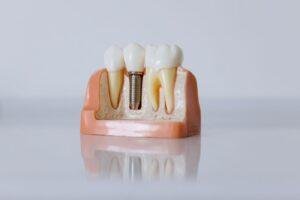
Yes, decay can form underneath a filling or a crown, and it’s one of the most common reasons dental work needs redoing.
Dentists call it recurrent decay or secondary caries. It’s common, it’s usually painless in the early stages, and it becomes serious if it’s left long enough to reach the nerve. That’s the whole reason restorations get checked at every exam rather than being treated as permanent.
If you’ve had the same tooth filling for over a decade and haven’t had it reviewed recently, it’s worth knowing what’s going on under there.
How does decay get under a filling?
A filling isn’t welded to your tooth. It’s held by a bond or a mechanical fit, and there’s a join between the two materials called the margin.
That margin is the weak point. Over years of chewing, temperature swings and flexing, it can open into a microscopic gap. Bacteria are much smaller than that gap.
Once they’re in, they’re in a sheltered spot. Your toothbrush can’t reach it, saliva can’t flush it, and fluoride has limited access. Decay there progresses with very little to slow it down.
Crowns work the same way. The crown itself can’t decay, but the natural tooth underneath and the margin at the gumline absolutely can, and that margin often sits right where plaque collects.
Why can’t you feel it?
Because the filling is doing its job as insulation.
Sensitivity happens when stimulus reaches the dentin tubules and travels to the nerve. A restoration sitting on top blocks that pathway, so decay can get well established before anything registers.
By the time a tooth with an old filling starts aching on its own, the decay has often reached the pulp, and the conversation shifts to root canal treatment rather than a simple replacement. Catching it earlier keeps the fix small.
How is hidden decay found?
Mostly with X-rays, because this is exactly the situation a visual exam can’t resolve. Decay under a restoration shows as a dark shadow at the margin or beneath the material.
Your dentist also checks the margin physically with an explorer, looks for staining or a visible ditch along the edge, and watches for a filling that’s chipped, cracked or has started to lift. A regular cleaning and exam is where most of this gets picked up, since the hygienist works directly over those margins.
Sometimes the only honest answer is that the restoration has to come out to see what’s underneath. Dentists don’t do that casually, but a margin that catches an explorer and shows a shadow on film usually tells its own story.
What signs should you watch for?
These don’t guarantee decay, but each one is worth mentioning at your next visit:
- A dark line or grey shadow around the edge of a filling
- Floss catching or shredding consistently in the same spot
- New sensitivity to cold or sweet in a tooth that already has work in it
- A rough or chipped edge you can feel with your tongue
- Food packing between that tooth and its neighbour
- Pressure or discomfort when biting on that specific tooth
- A bad taste or persistent odour from one area
- A crown that feels loose or clicks slightly
A note on urgency. Swelling, a pimple on the gum near the tooth, throbbing that wakes you up, or pain that spreads to your jaw or ear means infection may have set in. That’s not a wait and see situation, and our emergency dentistry service exists for exactly this.
How long do fillings and crowns actually last?
Longer than people expect, but not forever. These are typical ranges rather than guarantees, since grinding, diet and hygiene shift them considerably.
| Restoration | Typical lifespan | Usual reason for replacement |
|---|---|---|
| Composite filling | 7 to 10 years | Margin breakdown, staining, chipping |
| Amalgam filling | 10 to 15 years | Cracks in the surrounding tooth |
| Porcelain or ceramic crown | 10 to 15 years | Decay at the gumline margin |
| Gold crown | 15 to 20 years or more | Margin decay rather than wear |
| Large old filling | Varies widely | Tooth fracture around it |
One pattern worth understanding: the bigger the filling, the more likely the tooth cracks before the filling fails. A tooth that’s mostly filling has little structure left to flex with, and a crown is often recommended before that happens rather than after.
What does treatment involve?
It depends entirely on how much tooth is still intact once the old work is removed.
Caught early
The old filling comes out, the decay is cleaned away, and a new filling goes in. One visit, and the tooth is usually stronger afterwards than it was with a failing margin.
More extensive decay
If too little tooth remains to hold a filling reliably, a crown is the usual answer. It wraps the remaining structure and takes the chewing load off the weakened walls.
Decay reaching the nerve
Root canal treatment is needed to clear the infection, and the tooth is then restored, almost always with a crown, since a root treated back tooth is brittle without one.
Extraction only enters the picture when the decay runs below the bone or the tooth has split. That’s the outcome early detection is designed to avoid.
How do you prevent recurrent decay?
- Clean between your teeth every day. Margins between teeth are where most recurrent decay starts, and a brush never reaches them.
- Keep your recall appointments. X-rays at sensible intervals are the only reliable way to see under a restoration.
- Report floss that shreds. It’s a mechanical signal that something at that margin has changed.
- Deal with grinding. Clenching flexes teeth and opens margins faster than normal chewing does.
- Use fluoride toothpaste, and ask about a higher strength version if you’ve had repeat decay.
- Cut grazing, not just sugar. Frequency of acid exposure matters more than total amount.
- Don’t ignore a chipped filling. A small repair now beats a crown later.
When to get an old filling checked
If it’s been more than two years since your last X-rays and you have several older restorations, that’s the sensible trigger. You don’t need symptoms, and waiting for them is how small problems turn into root canals.
Hummingbird Dental Clinic is on Yonge Street in Richmond Hill, a Top Choice Award winning clinic caring for families across Richmond Hill, Oak Ridges, Thornhill, Markham, Vaughan, Maple, Aurora, King City and North York. We’re accepting new patients, and we’re happy to review existing dental work as a second opinion.
We’re open Tuesday to Saturday, with evening appointments Tuesday and Saturday mornings. We accept the Canadian Dental Care Plan and most private insurance plans, and we can submit a predetermination so your coverage is clear in advance.
Call 647-370-2024, text 437-995-0592 or email info@hummingbirddental.ca. Find us at 10376 Yonge Street, Unit 202. Our dentists are licensed and regulated by the Royal College of Dental Surgeons of Ontario.
Frequently asked questions
Can a crown itself get a cavity?
The crown material can’t decay, but the natural tooth underneath it can, usually starting at the margin where the crown meets the tooth near the gumline. That margin is a common plaque trap, which is why crowned teeth still need flossing and regular X-rays.
Does decay under a filling always mean a root canal?
No. Most cases caught at a routine exam are handled with a replacement filling. A root canal becomes necessary only when the decay has reached the pulp, which is more likely if the tooth has been aching spontaneously.
Should I replace old fillings before they fail?
Not automatically. Replacing a sound filling removes more tooth structure each time, so a restoration that’s intact and sealed is usually left alone and monitored. Replacement is indicated when there’s decay, a crack, a failing margin or a fractured surface.
Why does my tooth hurt only when I bite on it?
Pain on biting in a tooth with a large filling often points to a crack rather than decay alone. The crack flexes under load and releases, which produces that sharp, specific pain. It needs assessment because untreated cracks tend to extend.
Can I see decay under a filling myself?
Rarely. A dark line at the edge can be staining rather than decay, and genuine decay is often entirely hidden beneath the restoration. This is one of the few dental problems where self assessment doesn’t work, and X-rays are the deciding factor.
In summary
Decay under existing dental work is common, quiet, and completely manageable when it’s found early. The margin is where it starts, so daily cleaning between teeth and periodic X-rays do most of the protective work. An old filling with no symptoms is still worth having looked at.