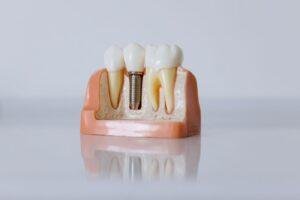
Short answer: no. Whitening gel has no effect on crowns, veneers, fillings or bridges. It only lightens natural tooth structure.
This catches people out all the time, and it’s not dangerous. It just means the order you do things in really matters. Whiten first and your existing dental work suddenly looks darker by comparison, because everything around it got lighter and it didn’t.
If you’re planning professional teeth whitening and you already have visible restorations, read this before you start rather than after.
Why doesn’t whitening work on dental work?
Whitening relies on peroxide breaking down stain molecules inside the porous structure of enamel and dentin. Natural teeth absorb the gel and the reaction happens within the tooth.
Porcelain, composite resin and ceramic aren’t porous in the same way. The gel sits on the surface and nothing penetrates, so the colour stays exactly where the lab or the dentist set it.
That colour was chosen deliberately to match your teeth on the day the work was done. The material is colour stable, which is normally a good thing. It’s only a problem when the teeth beside it change.
What happens if you whiten anyway?
Nothing harmful to the restoration itself. Peroxide won’t damage well bonded porcelain or a sound filling.
The visible result is a mismatch. A front crown that blended perfectly can end up looking grey or yellow against newly whitened neighbours, and the effect is more obvious than the original shade difference ever was.
There’s a second issue worth knowing. Whitening gel can seep slightly along the margin where an old filling meets the tooth, which sometimes causes temporary sensitivity. Our cosmetic dentistry assessments check the condition of existing margins before whitening starts, partly for this reason.
If a restoration is already leaking or has decay underneath, whitening isn’t the treatment that’s needed first.
Which materials respond and which don’t?
Here’s how the common materials behave. Details of each restoration type sit under our restorative dentistry services.
| Material | Lightens with whitening? | What to do instead |
|---|---|---|
| Natural enamel | Yes | Standard whitening works |
| Porcelain veneers | No | Replace or polish professionally |
| Porcelain or zirconia crowns | No | Replace to match new shade |
| Composite fillings and bonding | No | Replace, usually straightforward |
| Amalgam (silver) fillings | No | Replace with tooth coloured material |
| Bridges | No | Replace the visible units |
| Surface staining on porcelain | Not by gel | Polishing can remove it |
Composite is the easiest and cheapest to redo, which is useful to know when you’re deciding whether to whiten at all. Replacing a single bonded filling after whitening is a minor appointment. Replacing three front crowns is not.
Whiten first or restore first?
Whiten first. Always, when visible restorations are part of the plan.
The logic is simple. Your natural teeth can change shade, your dental work can’t. So you establish the final shade of the teeth, then match the restorations to it. Doing it the other way locks you into your current colour.
The sequence usually runs like this:
- Exam and shade record. Existing restorations are checked for decay, leaking margins and wear.
- Cleaning. Surface stain comes off first, because some of what looks like discolouration isn’t in the tooth at all.
- Whitening. In office, take home trays, or a combination.
- Settle for two weeks. Shade rebounds slightly and stabilises, so matching too early gives a false target.
- Match and replace. New bonding, veneers or crowns are made to the new shade.
That two week wait is the step people want to skip, and it’s the step that prevents a mismatch.
How do you fix work that already doesn’t match?
It depends what the restoration is and how visible it is.
Fillings and bonding
Usually replaced in one visit. The old composite is removed and new material is placed to the current shade. This is the most common fix after whitening and the least involved.
Crowns and veneers
These have to be remade, since the colour is baked into the ceramic. Replacement of porcelain veneers is planned properly rather than rushed, and it’s a reason to think about timing before whitening rather than after.
Surface stain on porcelain
Sometimes the restoration hasn’t changed colour at all and has simply picked up film from coffee, tea or smoking. Professional polishing removes that. It’s worth ruling this out before assuming anything needs replacing.
What about whitening toothpaste and strips?
Same rule applies, with one addition. Whitening toothpastes work mostly by abrasion, scrubbing surface stain off rather than changing the tooth’s internal colour.
On porcelain that’s mostly harmless. On composite fillings, repeated abrasive scrubbing can dull the polish over time and make them pick up stain faster. Gentler is better if you have visible bonding.
Strips have a further limitation. They sit flat against the front surfaces and rarely reach between teeth or along the gumline evenly, so results tend to be patchy even on natural enamel.
Talk to a dentist before you start
A short consultation saves money here, because the main cost of getting this wrong is replacing dental work you didn’t need to replace.
Hummingbird Dental Clinic is on Yonge Street in Richmond Hill, and we’re a Top Choice Award winning clinic serving families from across York Region, including Thornhill, Markham, Vaughan, Oak Ridges, Aurora and North York. We’re accepting new patients.
We’re open Tuesday to Saturday with evening appointments on Tuesday and Saturday mornings. We accept the Canadian Dental Care Plan and most private insurance plans, and we can submit a predetermination so you know where you stand before treatment begins.
Call 647-370-2024, text 437-995-0592 or email info@hummingbirddental.ca. We’re at 10376 Yonge Street, Unit 202. Our dentists are licensed and regulated by the Royal College of Dental Surgeons of Ontario.
Frequently asked questions
Will whitening damage my crowns or veneers?
No. Peroxide gel won’t harm sound porcelain, ceramic or well bonded composite. The risk isn’t damage, it’s a colour mismatch once the natural teeth around the restoration lighten and the restoration stays the same.
How long should I wait after whitening before getting a crown?
About two weeks. Shade rebounds a little after whitening and then stabilises, and bonding strength is also temporarily reduced straight after treatment. Waiting gives both a true final shade and a more reliable bond.
Can a discoloured veneer be whitened from behind?
Not usefully. If the underlying tooth has darkened and shows through a thin veneer, internal whitening of that tooth is occasionally possible, but it’s case specific. In most situations replacing the veneer gives a more predictable result.
Do silver fillings get lighter with whitening?
No. Amalgam is metal and doesn’t change colour. Whitening the surrounding tooth often makes a silver filling look more obvious. Many people choose to replace visible amalgam with tooth coloured material as part of the same plan.
Is in office whitening better than take home trays?
They reach similar end points by different routes. In office is faster and useful for a deadline. Custom take home trays work more gradually, often with less sensitivity, and the trays can be reused later for top ups. Many people combine both.
The takeaway
Crowns, veneers and fillings don’t whiten, so the sequence is what protects your result. Whiten your natural teeth first, let the shade settle, then match any restorations to it. A consultation beforehand is the cheapest part of the whole process.